Is GATE Worth It If You Already Have a Tech Job Offer?
A tech offer and GATE preparation serve different goals. Use a practical framework to decide whether to accept, defer, or prepare alongside work.
KnowledgeGate Team
Exam prep & CS education
Updated 25 Sep 20266 min read63 views

A tech offer can make the GATE decision feel urgent: accept a real opportunity now, or spend months preparing for a result that may or may not change your path. The useful question is not whether GATE is prestigious. It is whether a specific GATE outcome is valuable enough to justify the time, money and uncertainty for you.
GATE can be used by institutes for postgraduate admissions and by some employers for recruitment, but a score alone does not secure either outcome.
The official GATE 2026 FAQ says admission and recruitment depend on the institute’s admission criteria or the employer’s process. Start with those rules, then compare them with the offer you actually have.
First, name what you want GATE to change:
“Better opportunities” is too broad to guide a decision. Write down the outcome you are aiming for. It might be a particular master’s programme, a research route, or a named employer that currently recruits through GATE in your paper. If the answer is only “a better future,” you do not yet have enough information to turn down an offer.
Check the current admission brochure or recruitment notification for that target.
Confirm the accepted paper, degree requirements, score or rank criteria, application timeline, selection stages and any other conditions. GATE’s official materials make clear that qualifying is not itself an admission or job guarantee.
Rules vary by programme and employer, so use their current official notice rather than an old cutoff chart or someone else’s result.
If you are exploring the exam path, the GATE preparation category brings together relevant preparation resources. The GATE Guidance course is one option to review when deciding what a structured study plan would involve.
Compare the offer you have, not an imagined job
Read the offer carefully and assess the actual role. Consider the work you would do, the skills you could build, pay and benefits, location, joining date, working hours, training, stability and the terms for accepting or declining. Ask the recruiter questions where the offer is unclear. A company name or salary figure alone cannot tell you whether the role fits your priorities.
Then compare that concrete role with the target outcome behind your GATE plan. Would the programme or job open a path you genuinely want? What would it cost to pursue it, and what happens if the result is not enough for your target?
Avoid comparing a real offer with a best-case version of postgraduate study or a hypothetical PSU role. Compare likely paths using the information available today.
A simple test helps: Would I choose this job if GATE did not exist?
If yes, accepting may be a sensible default while you assess whether preparation can fit around work. If no, identify what is missing from the role and whether a defined GATE route is a realistic way to address it. The answer is personal; there is no universal rule that a job offer should always win or that GATE preparation should always take priority.
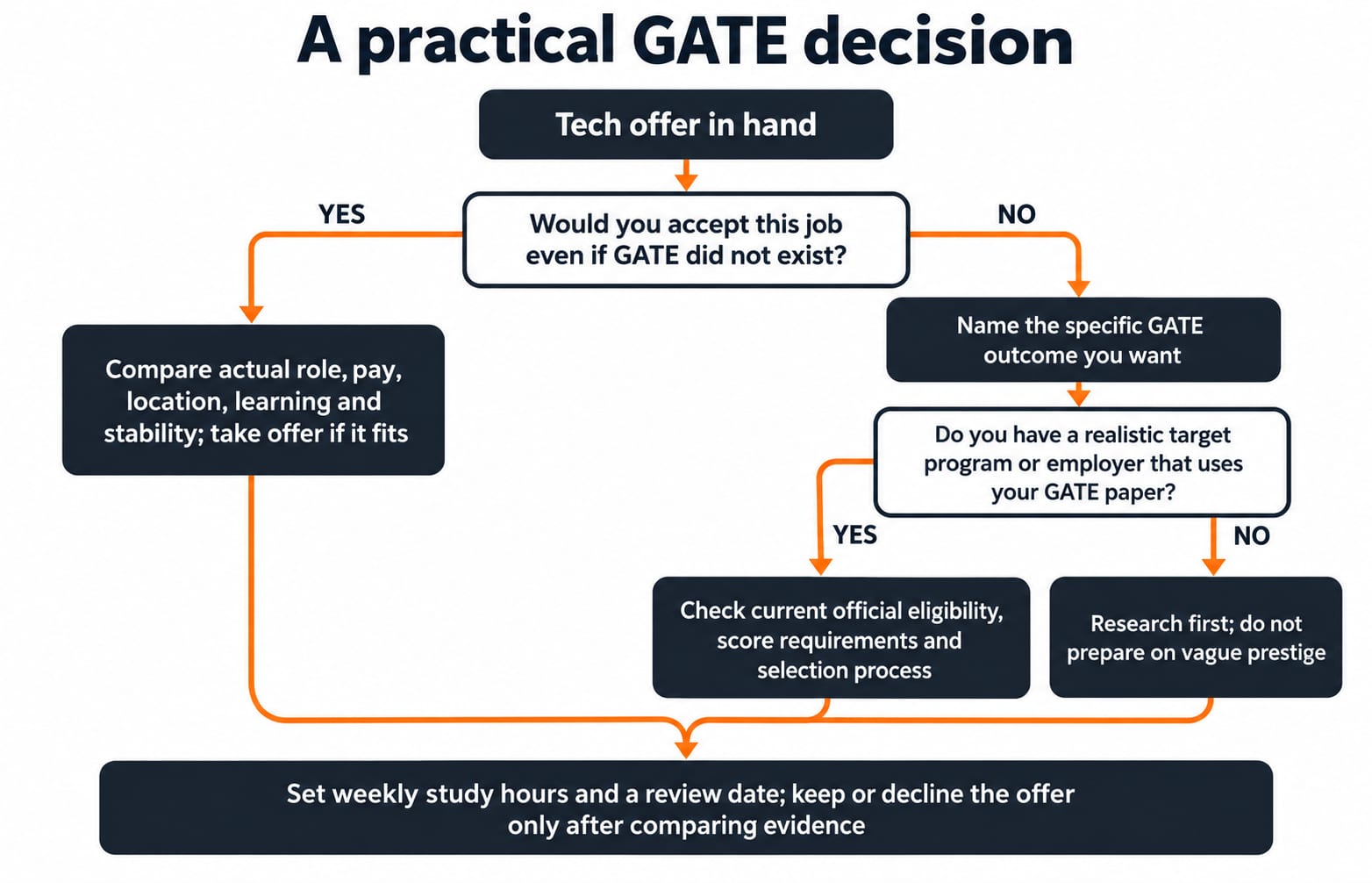
The four realistic routes
You are not limited to “quit and prepare” or “forget GATE.” Consider these routes:
Accept the offer and prepare alongside work. This can preserve income and experience while keeping a target open. It only works if the job’s schedule leaves a sustainable study window and you can protect time for concepts, practice, revision and mock analysis.
Accept the offer and postpone the exam decision. Learn what the role is actually like, then reassess against a defined date and target. Check eligibility and application deadlines before postponing; do not assume you can enter every future cycle on the same terms.
Decline or defer the offer and prepare full-time. Consider this only when you have a specific target, a realistic plan, financial runway, and a fallback if the score or selection outcome is not what you want. Check the written offer terms before asking for a deferral.
Accept the offer and decide GATE is not your route. That is valid if the job aligns with your goals and the outcomes available through GATE do not justify the trade-off for you.
If you are leaning toward employment-oriented skills and interviews, browse the Placement Preparation category as a separate resource path. It does not replace evaluating your own offer; it can help you identify skills to build whichever route you choose.
Calculate the opportunity cost honestly
Make a two-column comparison for the next year or two.
In one column, list what accepting the offer gives you: income, work experience, mentorship, a chance to test the role and other concrete benefits.
In the other, list what focused GATE preparation might make possible and what it requires: study time, course or exam expenses, delayed income, uncertain results and the admission or recruitment criteria you still have to meet.
Do not treat salary now and a possible future salary as directly comparable without evidence. Likewise, do not count “a better college” as a guaranteed return.
The GATE 2026 scorecard is valid for three years according to the official FAQ, but validity only preserves the score for possible use; each institution or employer still sets its own process. Check the current-year official rules for the cycle you plan to target.
Talk through the decision with people who know your finances and goals. A family member, mentor or current employee in the target role may surface constraints you have missed. Ask specific questions: What does this role look like day to day? Which programmes accept this paper and degree? How much preparation time can I sustain with this schedule? What is my fallback if I do not reach the target?
If you keep the job and prepare, set boundaries
A plan that assumes perfect evenings is not a plan. Before accepting a dual track, write down realistic weekly study hours around work, commute, sleep and personal responsibilities. Try that schedule for a short review period and track whether you complete planned learning and practice, rather than judging by hours at a desk.
Choose a review date before the exam application or any offer deadline that matters.
At that checkpoint, check progress, energy, work conditions and the latest official requirements. If the schedule repeatedly fails, revise the route early: adjust your target, pause preparation, or reconsider the role if the offer’s terms allow it. A review date turns “I’ll do both somehow” into a decision you can revisit with evidence.
For a perspective on how much one result should define your future, read Will a Low GATE Rank Ruin Your Career?. And when comparing possible admission outcomes, Why Two Students With the Same GATE Score Get Different College Options explains why the score is only one part of an institute’s decision.
So, is GATE worth it?
It can be worth pursuing when you can name the outcome, verify that your paper and degree fit the current rules, and accept the cost and uncertainty of the route. A tech offer can also be worth accepting when the actual role supports your goals or gives you a practical base while you prepare.
The choice depends on the fit between those paths and your circumstances, not on a slogan about taking the “safe” or “ambitious” option.
Before you decide, write down one target, one verified official route to reach it, the cost of pursuing it, and a date to reassess. Then compare that plan with the written offer.
If GATE remains your goal, explore the GATE category and build a schedule you can sustain. If the offer is the better fit, accept it deliberately and keep developing the skills your next step requires.
Keep learning

GATE MSQs: How to Avoid Option Traps
A practical elimination method for GATE MSQs: test each claim, spot common option traps, and understand why partial selections earn no credit.
5 Oct 20265 min readGATE CS Preparation
GATE CS Study Plan for Working Professionals
A practical GATE CS plan for working professionals: a 12-hour weekly timetable, flexible subject roadmap, PYQ practice, revision and mock analysis.
1 Oct 20266 min read73 viewsGATE CS Preparation
How to Build an 'Error Log' That Boosts Your Exam Score by 20%
1 Oct 20263 min readGATE CS Preparation

Decoding the GATE Virtual Calculator: Speed Hacks & Common Miscalculations
A practical guide to the GATE on-screen calculator: function-entry order, memory keys, angle modes and NAT precision.
29 Sep 20266 min readGATE CS Preparation