Why Two Students With the Same GATE Score Get Different College Options
A GATE score is important, but it is not a seat-allocation formula. Here is why two candidates with the same score can see very different college options.
KnowledgeGate Team
Exam prep & CS education
19 Sep 20266 min read

Why Two Students With the Same GATE Score Get Different College Options?
Two students can open their GATE scorecards, compare the number, and still end up with very different college shortlists. One may be eligible for a programme that the other cannot apply to. One may receive an offer in an early counselling round, while the other may need to wait, change preferences, or consider a different institute.
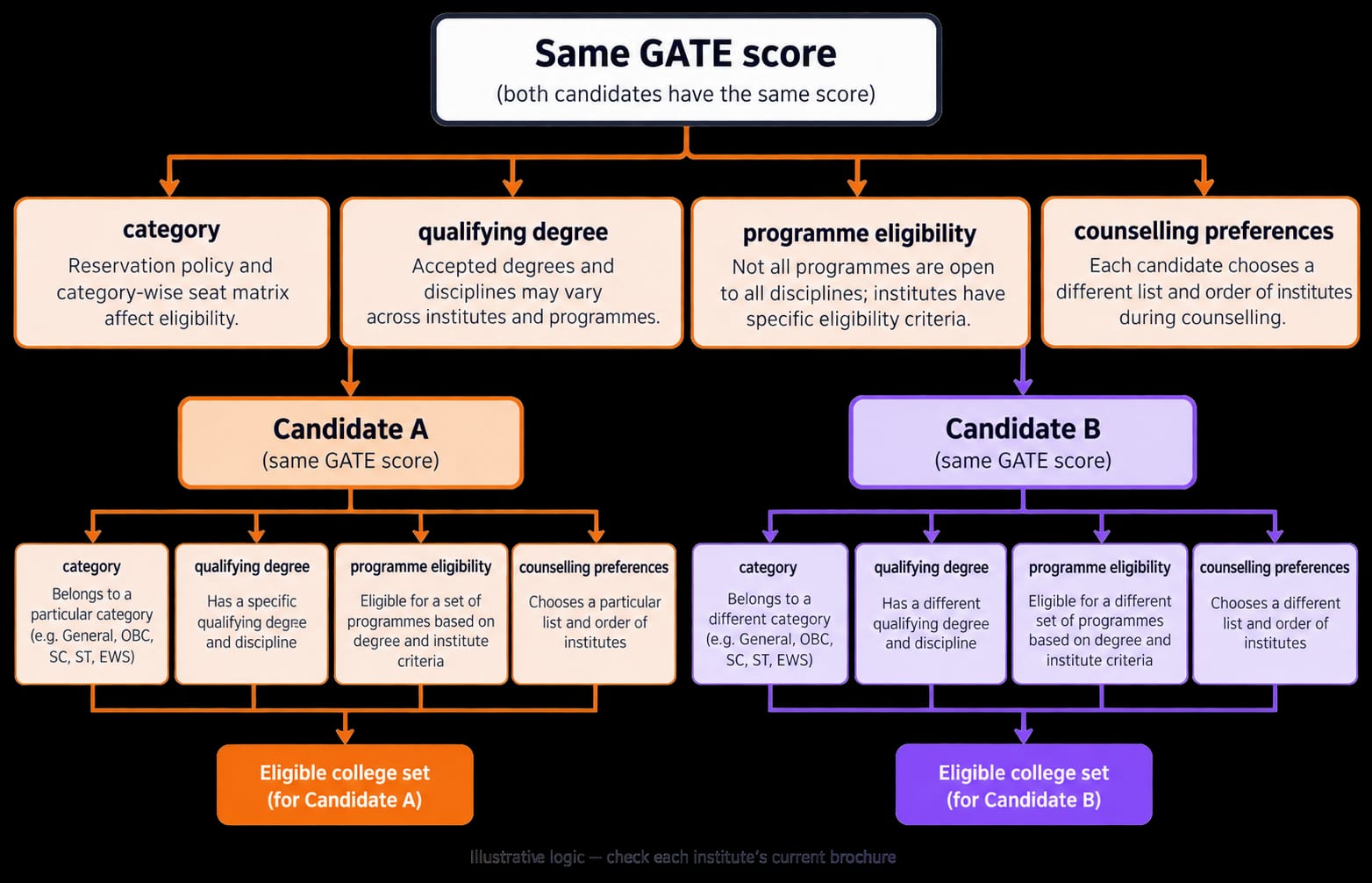
This is not necessarily an error in the admission process. A GATE score is an important input, but it is only one part of the decision. College options are created by combining the score with the candidate’s rank, category, qualifying degree, programme rules, seat matrix, application route, and preference order.

A GATE score is not the same as an admission offer.
The easiest way to understand the difference is to separate three stages:
The exam stage: you receive marks, a score and a rank-related position.
The eligibility stage: each institute or programme checks whether you meet its rules.
The allocation stage: available seats are matched with eligible candidates, their category, and their counselling preferences.
Your score matters at all three stages, but it does not replace the other checks. A candidate with a strong score can still lose an option if the qualifying degree is not accepted, the programme is not open to that paper or discipline, the required category document is missing, or the candidate does not select the institute in the counselling list.
For the broader exam context, see the GATE preparation category. It is useful to treat the scorecard as the starting point for research rather than the final answer to the question, “Which college will I get?”
1. Category changes the seat pool and the comparison point
Institutes do not evaluate every applicant against one identical seat pool. Reservation policies, category-wise seats, and category-specific qualifying requirements can change the set of options visible to two candidates with the same score.
For example, Candidate A and Candidate B may have the same GATE score but belong to different categories. Their applications may be considered against different seat pools and different closing positions. That does not mean one candidate is guaranteed a particular institute. It means the comparison must be made using the relevant category and the institute’s current admission rules.
There is also a document-checking risk. A category benefit generally depends on valid, correctly formatted and current documentation. If a certificate is unavailable or does not meet the stated requirement, the candidate may be considered under another category or may lose eligibility for a particular seat. The exact rule is institute-specific, so read the current brochure instead of relying on a coaching prediction or a previous-year screenshot.
2. The qualifying degree can open or close programmes
The same GATE score does not give every candidate access to the same list of M.Tech or related programmes. A programme may accept only certain undergraduate degrees, disciplines, or GATE paper codes.
Consider two candidates with the same score:
Candidate A has a qualifying degree that appears in the programme’s accepted-degree list.
Candidate B has a different degree and must check whether that programme explicitly accepts it.
If the programme accepts only Candidate A’s background, Candidate B cannot compete for that seat merely because the score is identical. The difference is eligibility, not performance.
This is one reason a college list copied from a friend can be misleading. Before adding a programme to your shortlist, record the accepted degree, required subjects, accepted GATE paper, minimum academic conditions, and any additional requirement. The programme title alone is not enough.
3. “Same score” may still mean different ranks or admission treatment
Students often use “score” to mean marks, GATE score, percentile, or rank. These are related, but they are not interchangeable. Admission notices may use a particular measure, and tie-breaking or merit-list rules can differ by institute.
The practical lesson is simple: compare the exact field requested by the institute. If the notice asks for GATE score, do not substitute a marks-based estimate. If it publishes a rank list, do not assume a score predictor is the final order. If two candidates appear tied, read the institute’s tie-breaking rule rather than guessing from a previous year.
4. Eligibility is programme-specific, not just college-specific
A common mistake is to ask, “Can I get into this IIT or NIT?” The more useful question is, “Am I eligible for this specific programme at this institute?”
The same institute may have different rules for different programmes. One department may accept a wider range of engineering degrees; another may require a closely related discipline. Some programmes may ask for particular subjects, a minimum academic record, a valid score in a specific paper, or an additional test or interview.
That creates a familiar situation: Candidate A sees a programme in the admission portal, while Candidate B does not see it or cannot complete the application. Both may have the same GATE score. The portal is reflecting programme-level rules, not making an arbitrary judgement about the score.
5. Counselling preferences turn eligibility into actual options
Being eligible for a programme and receiving that programme are different outcomes. After checking eligibility, the system still has to consider seat availability, candidate order, category, institute rules and the preferences submitted by the candidate.
Two candidates may have the same score and be eligible for the same five programmes, but their final options can still diverge because they arranged their choices differently. A candidate who places a programme higher may be considered for it earlier than a candidate who places it lower. A candidate who does not list an institute cannot receive it through that preference list, even if the score would otherwise have been competitive.
This is why counselling should be treated as a decision exercise, not a formality.
Make three lists:
Ambitious options: programmes you would choose if the allocation works in your favour.
Realistic options: programmes where your profile appears competitive after checking the rules.
Safe options: acceptable programmes you would genuinely join, not random names added to fill the list.
Also record whether the option belongs to an IIT-led process, a common counselling process, or an institute-specific application. The process and deadlines can differ, so confirm them on the official portal.
A simple example
Suppose two candidates have the same GATE score. Candidate A has a qualifying degree accepted by a particular computer science programme and submits that programme near the top of the preference list. Candidate B has a degree that the programme does not list as eligible and places a different programme first.
Candidate A may see the first programme as an available option. Candidate B will not. If both candidates are eligible for a second programme, their preference order and the seats available in each round can still produce different offers.
Nothing in this example says that one score is “better.” It shows that the score is being applied inside two different admission profiles.
How to build a reliable GATE college shortlist
Create a spreadsheet with one row per programme and these columns:
Institute and programme name
Accepted GATE paper
Accepted qualifying degrees or disciplines
Minimum academic requirements
Category and certificate requirements
Admission route and application deadline
Additional test or interview, if mentioned
Your preference order
Official brochure link
Status: eligible, needs clarification, or not eligible
Use the GATE Test Series to improve your exam performance, but use official brochures to decide where that performance can be used. If mathematics is affecting your score, the Engineering Mathematics for GATE course is another relevant preparation resource.
For a broader planning framework, you can also read GATE preparation and GATE strategy and roadmap. Use those guides for preparation direction; use current institute documents for admission decisions.
Final takeaway
Two students with the same GATE score can have different college options because admission is not based on the score alone. Category, rank interpretation, qualifying degree, paper eligibility, programme rules, seat availability and counselling preferences all shape the final list.
The safest approach is to stop asking only, “What college does this score get?” Instead, ask: “Which programmes accept my profile, which options are available through the relevant counselling route, and how should I order them?” That question leads to a shortlist you can defend with official evidence rather than a prediction that may not apply to you.
Keep learning

GATE MSQs: How to Avoid Option Traps
A practical elimination method for GATE MSQs: test each claim, spot common option traps, and understand why partial selections earn no credit.
5 Oct 20265 min readGATE CS Preparation

GATE CS Study Plan for Working Professionals
A practical GATE CS plan for working professionals: a 12-hour weekly timetable, flexible subject roadmap, PYQ practice, revision and mock analysis.
1 Oct 20266 min read73 viewsGATE CS Preparation

How to Build an 'Error Log' That Boosts Your Exam Score by 20%
1 Oct 20263 min readGATE CS Preparation

Decoding the GATE Virtual Calculator: Speed Hacks & Common Miscalculations
A practical guide to the GATE on-screen calculator: function-entry order, memory keys, angle modes and NAT precision.
29 Sep 20266 min readGATE CS Preparation