GATE CS Study Plan for Working Professionals
A practical GATE CS plan for working professionals: a 12-hour weekly timetable, flexible subject roadmap, PYQ practice, revision and mock analysis.
KnowledgeGate Team
Exam prep & CS education
1 Oct 20266 min read72 views

After a full workday, a four-hour study target can look impressive on paper and collapse by Wednesday. A useful GATE CS study plan for working professionals starts with the hours you can protect, then gives those hours specific jobs: learning, problem solving, revision and testing.
This guide proposes a 12-hour week and a flexible 24-week roadmap. These are planning examples, not a promise of syllabus completion or a particular rank. Your starting knowledge, work schedule and time until the exam decide how quickly you can move.
Start with a diagnostic and the current syllabus
Before buying another resource, download the CS syllabus from the official GATE syllabus page. The official site flags revised syllabi for GATE 2027, so check your notes and older course playlists against that version.
Make a checklist for engineering mathematics, digital logic, computer organization, programming and data structures, algorithms, theory of computation, compiler design, operating systems, databases and computer networks. Track general aptitude separately. This is an organizing list; the official document defines the topic-level scope.
Attempt a small diagnostic across these subjects without opening solutions. Mark each topic as familiar, rusty or new. A software job may help with programming, but it does not establish exam readiness in automata, probability or cache calculations. Let your answers decide where to start.
Write down your reason for taking GATE too: postgraduate study, research or another specific goal. If you are still weighing the career decision, read Is GATE Worth It If You Already Have a Tech Job Offer? before committing your weekends.
A weekly timetable that fits around a job
Reserve 75 focused minutes on Monday to Thursday, one hour on Friday, and three hours on each weekend day. That adds up to 12 hours: four times 75 minutes, plus 60, plus 180, plus 180, equals 720 minutes. Breaks are additional to the study budget.
Day | Study time | Session output |
|---|---|---|
Monday | 75 minutes | Learn one small topic and solve an example |
Tuesday | 75 minutes | Solve related PYQs and review mistakes |
Wednesday | 75 minutes | Learn the next topic and test recall |
Thursday | 75 minutes | Solve a timed set and correct errors |
Friday | 60 minutes | Revise mathematics, aptitude and old errors |
Saturday | 180 minutes | Complete a topic, solve PYQs and consolidate notes |
Sunday | 180 minutes | Take a topic test, review it and plan the next week |
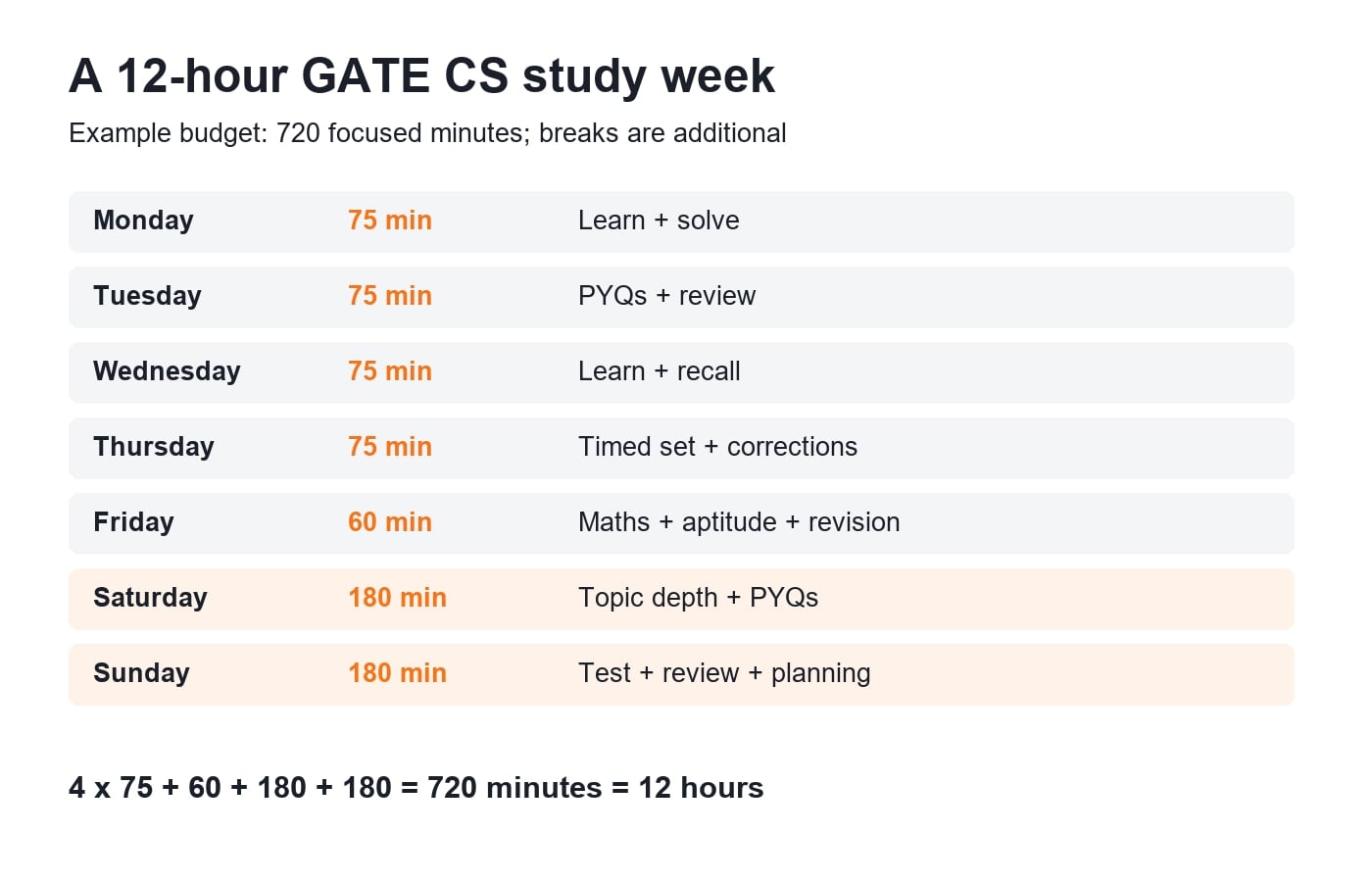
Choose morning or evening according to your energy and work demands. A regular slot before unpredictable meetings can be easier to defend. Keep commute revision optional, and only use it when you can travel safely without needing to drive or navigate.
For a weekday learning block, try 10 minutes of recall, 35 minutes of focused study, 25 minutes of questions and five minutes recording the next step. On practice days, shift more time to solving and reviewing. End with something observable: a solved set, a corrected misconception or a short note you can explain without looking.
Use a flexible 24-week subject roadmap
The following sequence groups related subjects. It assumes some undergraduate familiarity and needs adjustment after the diagnostic. A beginner may need more than 24 weeks at this weekly budget.
Weeks | Main focus | Check before moving on |
|---|---|---|
1–4 | Programming, data structures and discrete mathematics | Trace code and solve representative topic questions unaided |
5–8 | Algorithms, digital logic and computer organization | Explain methods and work through numerical problems |
9–12 | Operating systems and databases | Solve mixed questions and revisit earlier subjects |
13–16 | Computer networks, theory of computation and compiler design | Identify weak subtopics from subject tests |
17–20 | Repair remaining gaps and revise all subjects | Complete mixed timed sets with an error log |
21–24 | Full mocks, analysis and targeted revision | Apply corrections in later tests |
Carry engineering mathematics and aptitude through every phase. Friday is their protected slot, supplemented by shorter practice within the week. Discrete mathematics appears early because it supports several CS topics; other mathematics topics still need their own checklist.
If a phase overruns, revise its scope and timeline. Do not declare a subject complete because its videos are finished. Use the GATE CS exam hub to choose structured resources, and the exam and course directory when a prerequisite needs repair. Keep one main learning resource per subject to reduce switching.
Turn PYQs into a learning loop
Start previous-year questions as soon as you finish a topic. Attempt them before reading explanations, record your reasoning and separate genuinely correct answers from lucky guesses. Check that older questions match the current syllabus.
Suppose you attempt 12 questions and answer eight correctly. Your set accuracy is 8 divided by 12, or about 66.7%; this is a practice measure, not your GATE score. Classify the four misses: perhaps two conceptual gaps, one calculation mistake and one misread condition. Next week's repair should address those causes rather than replaying the entire subject.
For each error, write the question source, the mistaken step, the correct idea and a reattempt date. Re-solve selected mistakes after a day or two and again the following week, without viewing the solution. If you still cannot solve one, return to its prerequisite.
Keep notes short enough to review. A page on CPU scheduling should contain the method, assumptions and a worked trace; it should not become a transcript of every lecture. Retrieval and fresh questions help you check whether the note is actually useful.
Schedule mocks and their review together
Use topic tests early, mixed tests as coverage grows and full mocks regularly in the final phase. The official GATE 2027 paper pattern gives CS a standard 180-minute examination with MCQ, MSQ and NAT questions. Follow any applicable approved timing accommodation when practising.
In a full-mock week, use Saturday's three-hour block for the test and Sunday's block for analysis. Replace the usual weekend tasks; do not silently add a mock on top of the timetable. If you need more review time, continue it in the next weekday session.
Review wrong answers, guessed answers and solvable questions you skipped. Distinguish missing knowledge from slow execution or poor question selection. Practise the virtual calculator as part of timed work; the GATE calculator guide covers common execution errors.
Choose three concrete corrections after each mock. For example: revise normalization, redo probability errors and abandon an unproductive question sooner. A score becomes useful when it changes the next week's work.
Recover from overtime without creating study debt
For a demanding workweek, use a maintenance schedule: three 30-minute weekday sessions and one two-hour weekend block. That is 3.5 hours for recall, selected error-log questions and one small practice set. It preserves contact with the material while reducing new learning.
When work settles, resume from the next unfinished topic. Do not double every session to repay missed hours. If overload persists, extend the timeline or reduce planned coverage deliberately while recording the gaps. Protect sleep and leave room for family commitments; an exhausted timetable is difficult to sustain.
If only 12–16 weeks remain, build from your diagnostic rather than squeezing this entire roadmap into half the time. Prioritize repairing familiar topics, maintain mathematics and aptitude, and reserve time for mixed tests and mocks. Record what remains unprepared so your expectations match your coverage.
Start with one week you can repeat
Tonight, download the current syllabus, choose your study slots and select the first topic using a diagnostic. This weekend, solve its questions and review what went wrong. Keep the plan if it works; adjust the workload if it does not.
Your first milestone is a repeatable week with completed questions and useful corrections. Build the next week from that evidence.
Keep learning

GATE MSQs: How to Avoid Option Traps
A practical elimination method for GATE MSQs: test each claim, spot common option traps, and understand why partial selections earn no credit.
5 Oct 20265 min readGATE CS Preparation

How to Build an 'Error Log' That Boosts Your Exam Score by 20%
1 Oct 20263 min readGATE CS Preparation

Decoding the GATE Virtual Calculator: Speed Hacks & Common Miscalculations
A practical guide to the GATE on-screen calculator: function-entry order, memory keys, angle modes and NAT precision.
29 Sep 20266 min readGATE CS Preparation

GATE CS vs. GATE DA: How to Decide Which Paper (or Dual Paper) to Target
GATE CS and GATE DA reward different strengths. Compare their syllabus, decide which fits your goals, and see how the official two-paper option works.
29 Sep 20265 min readGATE CS Preparation